Showing posts with label Greece. Show all posts

Sunday, July 19, 2026

Mykonos Island- Greece


The island with the windmills.


The beautiful sunsets.


Mykonos is an island in the Cyclades group
 in the Aegean Sea. 
Iconic on the island are the 
landmark16th century windmills.
The island is about 33 square miles and has
about 10,700 inhabitants.
The largest town is Chora.

The white-washed buildings and painted stone
walkways are beautiful.

Tender boats bring the cruise members
 to the island and back.
It is a beautiful island to walk around 
and enjoy the island breeze.


We have been there three times
 and each time we have enjoyed the
flowers and sights.

Just to see the windmills that have 
been there for so long is amazing.


Mykonos- we plan to be back.


Our 2026 Footsteps of Paul Group.


Monday, May 26, 2025

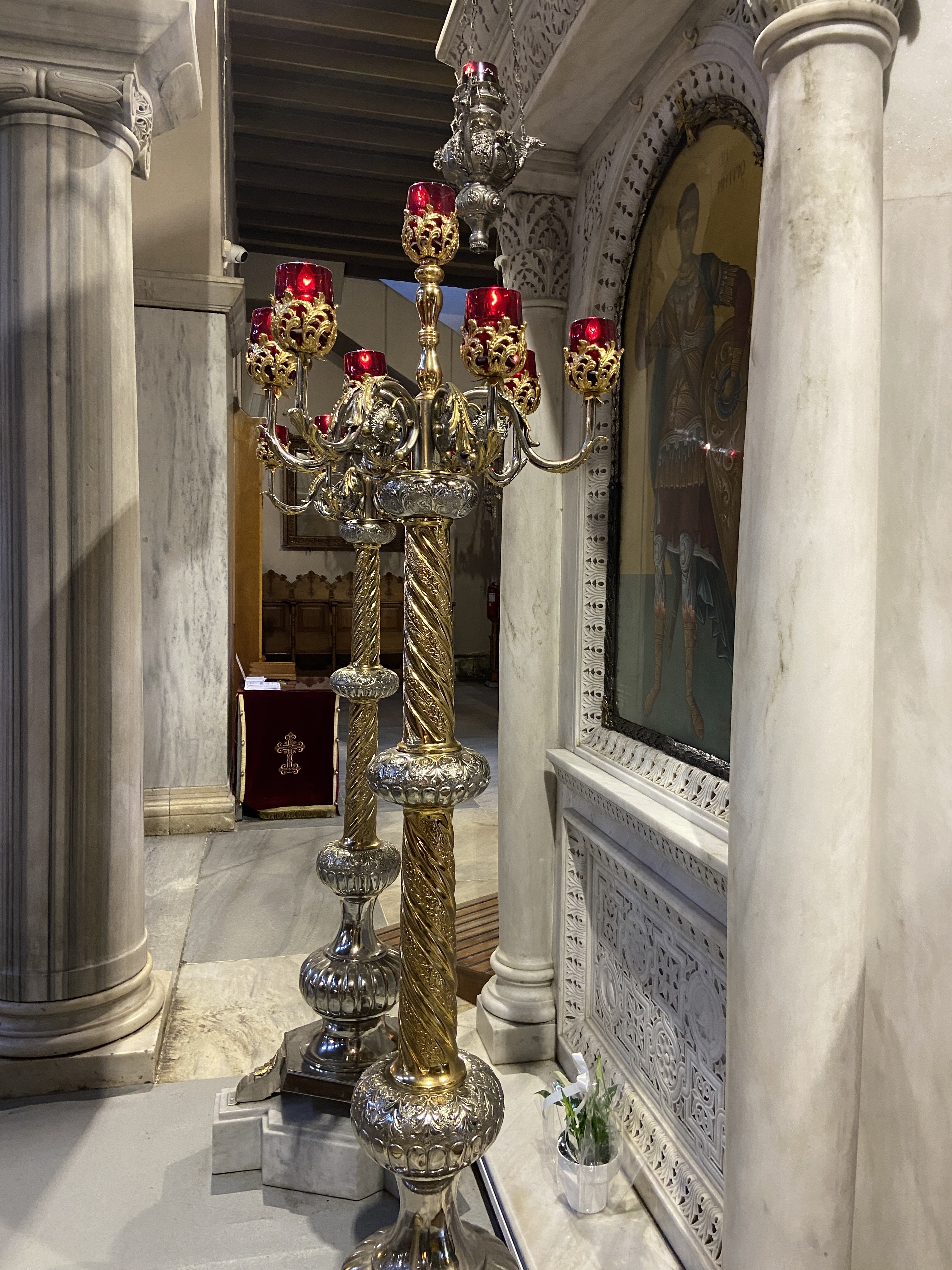
Saint Demetrius Church- Thessaloniki


Saint Demetrius Greek Orthodox Church-
 Thessaloniki

The first church on this site was constructed 
in the early 4th century AD, replacing a Roman bath.
A century later, a prefect named Leontios replaced
 the small oratory with a larger, three-aisled basilica.
Later years saw it gutted by fires 
and was then reconstructed as a five-aisled basilica in 629-634. 
This is the surviving form of the church much as it is today.
It was converted into a mosque in 1493, 
and was restored to Christian worship in 1912. 
But, then it was again destroyed in the a great fire in 1917.
It was rebuilt and started to function again in 1949.


Tombstones from the city's Jewish cemetery - destroyed by
 the Greek and Nazi German Authorities- 
were used as building materials.


Saint Demetrius died by martyrdom under the 
Christian persecutions of Emperor Galerius.
He was executed by Emperor Maximian in Thessalonica,
being stabbed with spears.


St. Demetrius Church is an opportunity to visit

 a very old -still in use- Greek Orthodox Church.


Demetrius is the patron saint of Thessaloniki.
 This dates back to when the city was the second largest 
city of the Byzantine Empire.
Since 1988, it has been on the UNESCO World 
Heritage List


Friday, May 23, 2025

Vergina- Greece


Vergina- The Royal Capital of Macedonia
Aegae was the first capital of ancient Macedonia. 
It remained in oblivion for about 23 centuries.
When it was found the famous treasures had been 
waiting patiently to be discovered.
The first excavation of the tombs were conducted by 
Greek archeologist Manolis Andronicos in 1977.
Everyone was amazed by the the finds in this setting.
Today the "Great Tumulus" with the royal tombs introduce
 to the public the magnificent discoveries
 in the Macedonian capital.
This area gave birth to King Phillip 
and to his son, Alexander the Great.
Aegae was the first capital until it was transferred to Pella.
But, the old capital continued 
to be the place for the royal tombs.
In 168 BC Aegae was conquered by the Romans who
likely caused the destruction by setting it on fire.
In the 14th century a small village called Palatitsa
 was mentioned in documents.
A small modern settlement was founded in 1922  
named after Vergina, the mythical queen of the area.
Areas of the palace and theater were excavated as early as 1861,
 with later work to the end of World War 2.

The facade of the tomb of Phillip II.

It is believed that the Great Tumulus-

a massive earthen hill, was formed during the years

 of the Macedonian King Antigonus Gonatus in 2nd Century B.C.

It was built to protect the sacred monuments

 against the desecration of hostile armies. 

Phillip was a masterful leader and military strategist.

He was assassinated in October  in 336 BC at Aegae.

Phillip and his royal court were gathered in order 

to celebrate the marriage of his daughter.

His bodyguard approached him and stabbed him in the ribs.

Alexander was pronounced King of Macedonia on the spot

and the funeral preparations for Phillip II began in that place.

 Clay vessels from the tombs.

The tomb area is thought to contain Phillip II,

and his wife Olympias. 

Also Phillip III- Alexander's half-brother and Alexander IV

 of Macedon (Alexander the Great's son)

It is also believed that one of the tombs 

contained Cleopatra, one of Phillip's wives. (He had seven.)


Copper vessels and other finds from the tomb of Phillip II.

Bottom left- the gold larnax with the twelve-ray star from
 the funeral chamber of the tomb of Phillip. 
The wreath of oak tree leaves is hanging above.
Bottom right-The iron breastplate found in the tomb of Phillip II.


The magnificent gold pieces found are remarkable.

Silver vessels and carvings.


Mural in the antechamber of the Prince's tomb.

There is still scholarly discussion about whether 
the tomb really holds Phillip II. But, does it really matter?
The findings here are from an ancient tomb that 
had not been robbed of its bounty. 
This is a wonderful picture of place 
and historic significance because it 
certainly was a king of Macedon.

Entrance to the museum over the Great Tumulus.

How does this site help a visitor find the story of Saint Paul?
It is a glimpse into the story of Alexander the Great, 
who wrote the history of the then-known world.
Alexander the Great's conquests and his establishment 
of the Hellenistic world significantly impacted
 the world of St Paul. 
His empire, while short-lived, spread Greek culture, 
language, and ideas throughout the eastern Mediterranean 
and beyond, 
creating a backdrop for Paul's missionary journeys.