Showing posts with label Israel Pilgrimage 7. Show all posts

Sunday, September 25, 2022

Tomb of Zechariah- Jerusalem


It is a lovely evening bus ride 

from the Dan Hotel in Jerusalem

 to the Kidron Valley to see the Tomb of Zechariah.

Well lit and stately, it stands tall to hold

 the limelight in the Valley landscape.

The ancient stone monument actually 

dates to a later time- probably 1st Century AD.

The monument is a monolith- 

completely carved out of solid rock 

and does not contain a burial chamber.

The Ionic order capitals are decorated with an 

egg and dart decoration suggests a Hellenistic influence.

The front side is fine masonry and decoration 

and the other side is extremely rough and unfinished

 as if the work had to be stopped before completion.

According to Jewish tradition,

 it was first suggested to be the tomb of

 Zechariah Ben Jehoiada in Jewish writings in 1215 CE.

    
                                   Nearby is the Tomb or pillar of Absalom.
                                         (and not so well lit)
It is also a monolith.
  Jewish tradition attributes it to Absalom, 
who was the rebellious son of King David
 about 1000 BC. Modern dating 
says the structure was built about First century AD.
It may have served as an ancient burial cave system
 connected to the Tomb of Jehoshaphat.
The free-standing monument contains a burial chamber
 with 3 burial sites with a complicated entrance and staircase.
 It has been compared to the burial structures found in Petra.
A leading archeologist, Gabriel Barkay 
believes this is the tomb of Herod Agrippa, 
the last of the Herodian rulers of Judea and Herod's grandson.
At one time it was nearly covered with  small rocks,
 as the Jewish people showed their disdain for a disobedient son.
It was uncovered in 1924.
Both of these tombs are at the base of the Mount of Olives,
 where it has evolved to be the largest Jewish cemetery.
According to Biblical projects and ancient Jewish writings,
 the Mount of Olives is the place the "End of the Days" 
will begin and those buried there will be the first 
who are resurrected to everlasting life.

A short walk showcases the evening light 
and beautiful gold glint
 of the Dome of the Rock.

An end to the evening is a stop by the 
Kotel at the Western Wall- (or Wailing Wall)
 for a moment of evening prayer.
This limestone wall in the Old City of Jerusalem
 is a small segment of the greater retaining wall.
The wall was erected as part of the expansion
 of the Second Jewish Temple begun by Herod the Great. 
This resulted in the encasement of the natural, steep hill
 known to the Jews and also the 
Christians as Temple Mount.


Monday, September 5, 2022

The Herodium- Israel


In 40 BCE, Herod had to flee for his life from 
Jerusalem and the hands of 
Hasmonean ruler Mattathias Antigonus. 
After Antigonus made a treaty with the Parthians 
(the eastern empire that was fighting the Romans at that time), 
he pursued Herod and his people. 
Herod barely survived the battle and he later chose to 
 build his tomb on the site.
 After the battle Herod went to Rome 
and the Senate crowned him King of Judea. 
It took him 3 years to be in control 
and become the sole ruler of the land, 
but under Roman domination.
In the third decade BCE, Herod began to build the Herodium.
It served as the government and administrative center of Judea. 
This left Jerusalem as mainly the religious center.
Though on the edge of the edge of the desert,
 it had abundant water brought from afar 
with gardens and bathhouses. 
Today it lies on the outskirts of modern day Bethlehem.
 Model of the buildings.
Herod planned the the gigantic site as a complex of palaces 
(the largest in the Roman world at the time).
It had a palace fortress, an entertainment area, administrative center and Herod's funeral complex- with tomb and a royal theater.
 In order that he would never be forgotten, 
he built an artificial mountain that covered 62 acres.

 
The palace was divided with a number of wings
 with a courtyard, bathhouses, 
dwellings and a grand reception hall. 
All of the palace walls were decorated 
with frescoes and stucco, with carved columns. 
                                                                                                                       Internet photo
It is quite the walk up to the top of the Herodian.

This is the rendering of the bathhouse.

This is the ceiling as it stands today.
And the entrance to the bathhouse.
This is the largest and most central of the cisterns dug 
into the slope of the early days of Herodium. 
 It appears the way it did during the Bar Kokhba Revolt. 
The large stones at the end come from Herod's tomb.

Herod's small but splendid royal theater
 is the oldest ever found in the country.
Built into the hillside,
 it was adjacent to the mountain palace fortress.
When Herod decided to transform the entire mountain
 into his mausoleum, he had the royal chambers
 and theater buried under tons of earth and stone.
The excavated theater today.

Stucco in the theater's royal chamber.

Windows on a sacred landscape. 
The style depicts a very unusual style for Judea 
and probably points to an artist from Alexandria.

This site also has extensive underground tunnels
 that were built during the Jewish revolts.
During the Byzantine period a small chapel 
was built in one of the wings to the cross-shaped courtyard. 
Monastic cells were also discovered in the ruined palace.

Research info:
Pilgrims began to visit here as early 
as the 15th century.
 Edward Robinson identified the site in 1838.
Father Corbo began excavation in 1962. 
Ehud Netzer began excavations in 1972. 
                                                                                                 Internet photo

In 2007, Netzer discovered the remains of a large tomb
 and opulent coffins. 
The shattered pieces of this sarcophagus were found 
and identified as Herod's and reside in the Israel Museum.
 He led the plans for a national park on this site.
 Prof. Netzer died in 2010 following a fall 
during work on the theater, not far from Herod's tomb.

Pilate's ring--In 1968–1969, 
a copper alloy ring was found and overlooked until 2018. 
The letters on it spell out Pilates 
and it certainly could have belonged to Pontius Pilate.

John and his sister, Lois, at the Herodium.

Though this site is not connected to Jesus, 
it is an amazing site.
It is located in the West Bank 
about 7.5 miles south of Jerusalem
 and 3 miles southeast of Bethelehem.
There are amazing buildings of Herod's design and 
 this is the only one named after him.


Thursday, August 11, 2022

Hamat Taverna National Park- Israel


I just don't know where the months

 have gone since our return from 2022 Israel tour.

As I can, I will try to tell the story 

of the places we visited. 

This trip we were able to visit 

Hamat Taverna National Park in Tiberias.


We had been chased all day by rain and a storm 

and when we got out of the bus this beautiful rainbow

dipping into the Sea of Galilee greeted us.

There are hot springs located here 

and the word Hamat is Hebrew for hot.

Hamat was mentioned as early as the thirteenth century BCE

 by an Egyptian traveler as a "'tourist site."

In Joshua 19:35 it is mentioned as the southernmost 

fortified city of the tribe of Naphtali.

In the Roman period, the city of Tiberius 

was founded and swallowed up Hamat. 

Most of the city has yet to be excavated.


A covered building protects the remains of the synagogue
 near the southern wall of the city. The synagogues were built
 over the ruins of older sites. The first was built around 230 CE.
 Here is a piece of the mosaic from a later building in the third
 or fourth century CE. building.
During much of this time the synagogue here
was the seat of the Jewish Sanhedrin.

The intricate mosaics are beautiful.

Here is the southern panel with the Holy Ark depicted
 along with Jewish symbols such as two seven-branched candelabra, 
a shofar (ram's horn) and a lulav (palm frond).

The northern panel depicts 2 lions flanking nine inscriptions

 in Greek dedicated to the donors.

These floors are the earliest such floor ever found

 in a synagogue in Israel.

This synagogue was destroyed in an earthquake 

in the fifth century.

A third synagogue was built and lasted until the 8th century.

The hot steam baths were used by the Arabs and built in 1780

 and used until the 1940's. 

Our guide, Yossi, treated us to the sound 

of the "music from the baths"

 from the building of Hamam Suleiman

 when the hot springs were used for their medicinal purposes.


Saturday, April 16, 2022

Church of the Holy Sepulchre and the Edicule

 The Church of the Holy Sepulcher in Jerusalem 

stands ornately over what would 

have been so obsure in the time of Jesus.
So quiet with only the guards on Holy Saturday

with a full moon.

This visit in January of 2022 was like no other visit. 
There were no crowds and no waiting lines
 because of the recent reopening of Israel in early January.
In the other 6 visits the lines to go into the Edicule 
were usually 5-6 hours long 
and we could never stay for those long lines.

                          The ornate shrine known as the Edicule 

encloses what is believed to be the tomb of Jesus Christ inside the Church of the Holy Sepulchre. 
The Shrine has undergone a recent extensive restoration. 
On some of our visits it was totally closed.

The wait to get inside was
 only a few minutes long.
Ornate carvings cover the inside of the edicule.

The original sepulcher had the obvious Jewish burial carved stone monument form. St Helen is said to have discovered this rock and it remained uncovered. Eusevious shared that the Holy Sepulchre was decorated with beautiful pillars but nothing 
was mentioned of it being enclosed.
A Pilgrim stated in 570 AD that the Holy Sepulchre was originally carved from a monolith surrounded by a circular wall. It remained this way until the church was destroyed by Al Hakim (1009-1012 AD) when the rock was leveled 
and the enclosing building was totally destroyed. 
The Church was restored by Constantinos Monomahos 
(1042-1048 AD) and finally enclosed in a new building.
The "anointing slab" sits without anyone around
 it- that would be the normal situation.

A beautiful mural is viewable 
without any crowd interference.
The Holy Sepulchre was closed on March 25, 2020 
and according to the keeper of the Keys ( a Muslim) 
this was the first closure since 1349 during the Black Death. 
Prayer continued inside the building until
 it reopened to visitors on May 24, 2020.

A normal visit is full of the cacophony of sound, bells,
 chanting and so many people. 
The visit this year was much more
 of a contemplative time,   
thinking of the death of Jesus-
and place of Resurrection for our Lord and Savior.
This Holy Saturday-
coming close to this spot
brings this amazing miracle to 
full Easter Light.


Monday, January 31, 2022

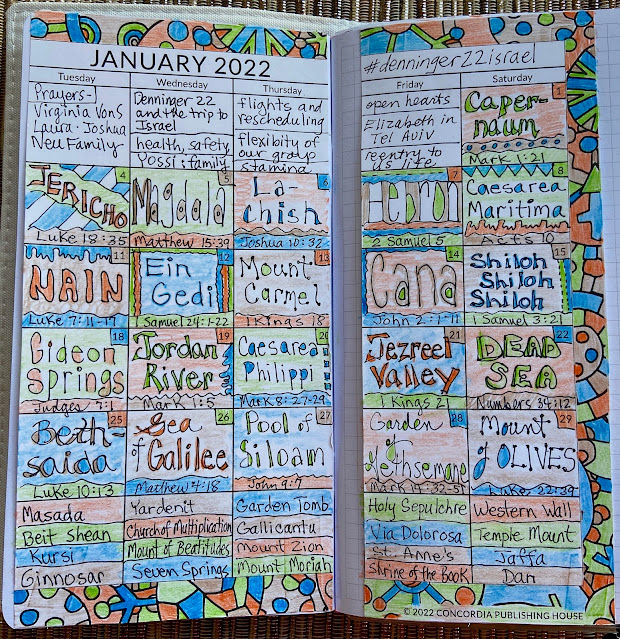
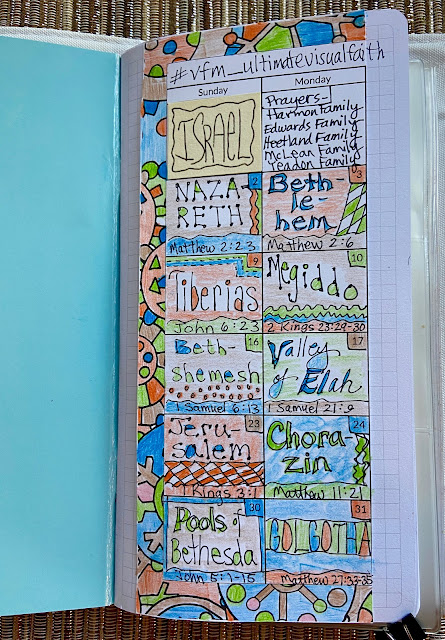
Scripture Doodles- January 2022


This month I set up a prayer month for the places 
we were going to visit in Israel 
for the Spiritual Pilgrimage we were leading.
We were very blessed to have our time there in 2022.
  Many friends had their tours canceled
 for the first part of January.
Four colored pencils was the plan.
I added the Bible Reference for my devotional time.
I used one square a day for a place we would visit. 
The section at the bottom of the calendar 
was for the overflow of sites we visited.

I loved having this Visual journey
 of our time in Israel.
It is a great way to share with others 
where we have been on our trip.
I tell people that it is really the 
Ultimate Visual Faith Experience.
Check out these hashtags on 
Instagram to find out more:
#denninger22israel
#vfm_ultimatevisualfaith